
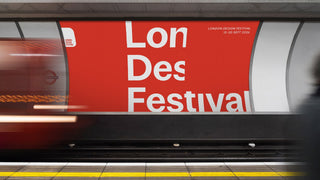
Design’s truest test isn’t the pavilion or the landmark. It’s the object in your hand. As the London Design Festival returns, we meet the maker of the Propress MINI.
It’s September and London is buzzing with creative energy. Marking the start of what’s been dubbed the arts season, for nine days London Design Festival spills out of studios and museums into the streets, from Soho Design District to Shoreditch, and with the V&A, our oldest champion of design, at its centre.
For its 24th edition, LDF is focusing on what impacts on us all: how craft and heritage and advanced technology can coexist, perhaps even benefit one another. You feel it in the projects across the city where the hand-made and the digital physically cross conversations. What’s great about this annual festival is that it is ultimately a celebration of innovation and creative thinking, with London and the UK seen as the platform for global conversations. And it’s free for everyone to join in.
The festival trades in the grand gesture: the pavilion, the landmark, the splashy brand, the object of desire. But design’s truest test is often far more modest. Good, thoughtful design is what lifts the most ordinary daily rituals: cooking, vacuuming, drying your hair. The humble domestic appliance is design’s real hero. Created with vision and with the user in mind, an appliance that doesn’t sacrifice beauty for function can turn a chore into something close to pleasure – or at least make us smile at its shape, its colour, its texture. As William Morris famously said, “have nothing in your houses that you do not know to be useful, or believe to be beautiful.”
This is what Propress has set out to do since the 1980s, with a single product in mind: the steamer. Unlike most electrical companies, Propress doesn’t make toasters, kettles, fridges or fans, which lets its designers and engineers focus on a single product. First came the full-size PRO range; then Propress's second-generation product, the MINI, a compact, more portable sibling made to the same exacting standards.

We spoke with Tim Oliver, Propress managing director and the man who led the design team, about the thinking behind this latest product.
What was the design brief for the Propress MINI?
The MINI was a personal project. Propress has always had a reputation for quality, performance and service, so the MINI had to fit that mantra. We were never going to make something cheap, and quality comes at a price. So we started with the features we would not compromise on, and left out the ones nobody uses or understands.

What would those be?
It had to be light enough to travel yet powerful enough to match our PRO range, with an aluminium faceplate, a steam plate large enough to cover fabric quickly, and a shape that wouldn’t catch or pull. It needed a long cord, since there’s nothing worse than a hotel steamer that can’t reach the top of a dress. And it needed the right water capacity: not so little it runs dry, not so bulky it looks like a cordless drill. So we gave it two hot-swappable tanks, a slimline one for travel and a Big Belly tank for up to 13 minutes’ steam.

What were you solving that the full-size PRO model didn’t?
Propress is quality all the way through. But the PRO range is big, not made to travel, and its longer heat-up time is a barrier if you just want to steam one item. The MINI works alongside the PRO in a commercial setting, but just as well on its own: dressing a shop window, touching up a bridal dress, or giving a curtain its last finish before the client arrives.
We started with the features we would not compromise on, and left out the ones nobody uses or understands.
Tim Oliver
How did you shrink so much technology without losing performance?
Performance is hard to measure, and specifications rarely tell you the full story. Our handheld is less powerful than many others and produces less steam per minute, but that is deliberate because it’s a fine balance of steam volume and plate temperature. The PRO makes more steam at a plate temperature of about 98°C and consistently. The MINI makes less steam and runs its plate much hotter, close to 135°C, which gives very similar results. The key is holding that temperature. If it drops, you get spitting, and that is bad news for delicate fabrics.

What was the hardest part of engineering heat and steam into a smaller body?
There is a lot to fit in, and it all has to be held in one hand. Because the MINI runs hotter than the PRO, we use different plastics inside so they won’t overheat. We also leave room for airflow, for the water that becomes steam, and for a circuit board or two. It comes down to the heater block: too small and the steam splutters; too big and it’s heavy. It has to work horizontally, like an iron, and vertically, like a steamer. It needs to feel right in both a woman’s and a man’s hands. And it has to be robust.
You can feel the quality the moment you pick up the MINI. Talk us through the material choices.
The case is high-performance plastic but doesn’t feel plasticky. The faceplate is aluminium with a ceramic coating, silky to the touch and smooth over fabric. The back mixes polished and textured areas so we can pick out the ‘lozenge’ from our logo, finished with the Propress wordmark.

How did you decide on the colour options: Arctic Grey, Vintage Pink, Idol Blue?
We didn’t want to go down the line of Henry Ford’s any-colour-so-long-as-it’s-black theory, nor offer so many colour options to confuse the consumer, so we landed on three. Grey for a neutral finish, a soft pink that we knew worked from experience, and, after a fair bit of research, a light blue that in some lights reads almost mint.
A single flat colour can look cheap, so each one carries our dark blue-black on the back moulding, which lifts the ‘lozenge’ pattern. They sell fairly evenly, though hotels tend to reach for Arctic Grey, bridal boutiques for Vintage Pink, and Idol Blue goes everywhere.
Good design, for us, is quality you can feel the moment you pick something up.
Tim Oliver
The names are intriguing…
We had great fun with these. The pink is a pastel, so it became Vintage Pink. The grey had an icy look and so it became Arctic Grey, although it was very nearly named Artic, like the lorry, caught just before it went to print. The blue defeated us for months. We referred to it as simply ‘bloody blue’ in the prototype stage. Then one day, driving through West Sussex, I passed a sign for the Blue Idol Quaker Meeting House, and so Idol Blue it became.
What does good product design mean to you?
Good design is quality you can feel the moment you pick something up. It has to be fit for purpose, first and always. We’re not chasing awards for the highest wattage or the most settings, those numbers are meaningless. After 45 years making nothing but steamers, we like to think we know a thing or two, and we still listen to our customers. We have always been our own harshest critics. We want something that looks good and works well, with nothing on it that doesn’t earn its place.
London Design Festival is on from 12 to 20 September 2026 on venues throughout the city.
Images: ©London Design Festival 2026, ©Propress