
Author: Nargess Banks
From Japanese kilns at the V&A to Ukrainian light at St Paul’s, the 2026 London Design Festival asked what still belongs to the maker, and how we can best collaborate with the machine.
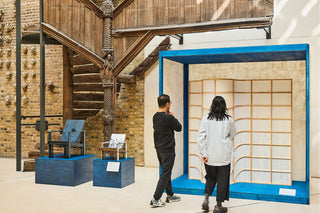
Modular ceramic pieces in luminous, lit-from-within greens greet us as we enter the Simon Sainsbury Gallery, nestled among architectural fragments and treasures from the V&A’s own Medieval and Renaissance collections. The room, often referred to as the daylit gallery for the natural light that floods in through the glass roof, is hosting Craft x Tech, as part of the 24th edition of London Design Festival.

The ceramic pieces are called Fushi and are the work of ceramic artisan Yohei Ito, who heads the Fudogama kiln that holds the centuries-old traditions of Mino Yaki. The pieces are made in collaboration with David Caon, an Australian industrial designer known for designing the Boeing 787-9 interiors and Airbus Project Sunrise. These two worlds couldn’t be more different. Yet it is exactly this contrast of craft and machine, different cultures, ancient tradition and cutting-edge technology that is at the heart of Craft x Tech.

Hideki Yoshimoto, founder of the design studio Tangent, is behind the initiative, and the premise is refreshingly simple: pair master artisans from Japan’s Tokai region with international designers, then stand back and observe what happens. The exhibition spans six craft regions, lacquer that takes months to cure, hammered metalwork, porcelain fired at searing heat, washi paper thin enough to let the light through, richly worked textiles.


Among the standouts is a two-piece collaboration between the Japanese contemporary artist Eugene Kangawa and Mayuki Kato of the pottery manufacturer Shingama: Chair, worked in the Japanese joinery styles of Nuki and Dami, and The Everyday at the Atelier. Both look, at a glance, like solid, functional furniture; they are anything but. These are intricate, delicate objets d’art, built on the brushwork and tonal variation of Seto Sometsuke Yaki, the region’s underglazed porcelain craft. “The variations within the deep indigo blue were fascinating,” says Kangawa, who sees in the collaboration’s trial and error a reminder that even techniques passed down for generations still leave room for new discovery.
The artist and designer, Isamu Noguchi, said that art was something that teaches human beings how to become more human. On a trip to Japan in 1951, he visited a traditional paper-lantern workshop and went on to create his Akari light sculptures that brought the centuries-old craft to the wider world. Yoshimoto says he’s working in the spirit of Noguchi. “The challenge, then as now, is that Japanese craft has many stories to tell, but those stories are not always shared,” he observes. “We need contemporary ways of thinking to expand design and craft’s possibilities.”
The Hand and the Machine
Craft is one strand of the Design Festival; the other is artificial intelligence and the machine. As the Industrial Revolution handed over making to the machine, and as the object became mass-produced and anonymous, the likes of William Morris and the Arts and Crafts movement fought back, insisting on the hand, the honest material and the dignity of the maker.
We are arguably living through even more critical times with AI pressing up against human intelligence in ways we don’t yet fully understand. And much like the Arts and Crafts rebels before them, today’s creative community is looking for ways to collaborate with the machine more knowingly, rather than simply resisting it or ceding it autonomy.

The V&A’s other major show, Awakenings, is asking such critical questions. In the Jameel Gallery of the Islamic Middle East, for instance, across from the 486-year-old Ardabil Carpet in its glass case, sits Sender Unknown, the work of the emerging artist Aziza Kadyri. She continuously feeds Uzbek suzani embroidery through an AI model to make new textile works, testing whether a technology that flattens a tradition might also help it survive.
Elsewhere, Linda Dounia Rebeiz takes a related angle with Once Upon A Garden, an installation that trains AI on the history of flowers that are barely recorded, thus conjuring 50 speculative species of flora. Nina Davies, meanwhile, imagines a collective trying to remake their own bodies in the likeness of AI-generated figures.

Similarly timely conversations continue across London through public art and installations, and through the design festival’s landmark projects staged in some of the city’s best-known spaces. One of the most moving this year was at St Paul’s Cathedral, where the Ukrainian artist Mykola Kabluka showed two light works. The Point of Unity’s mirrored surfaces reflect the sky by day and turn into a field of stars by night through 3,500 fibre-optic points, set to a soundtrack drawn from astronomical data. Its companion, Soul, is generated live through light, glass and movement, so no image ever repeats. Created by an artist living through war, the two works ask how we hold on to hope in dark times.
The same week, across the Channel, Paris was asking similar questions. Paris Design Week ran under the banner Design in Motion, its work filling the city’s grandest rooms, from Uchronia’s giant bloom beneath the dome of the Grand Palais to the Irish cabinetmaker Joseph Walsh’s ash sculptures in the orangery of the Hôtel de Sully.
What London and Paris staged this September amounted to one long debate, carried out in objects and installations. On one side, our humanity, and its long memory; on the other, the machine, our own invention, and its speed. The real question is finding where the two meet in harmony. The best work asked where that line should fall, and left it open, which is why design, and the culture it carries, needs to keep asking.
London Design Festival, 12 to 20 September; Paris Design Week, 10 to 19 September 2026.
Photography from top: Craft x Tech at V&A ©Ed Reeve; The Point of Unity and Soul by Mykola Kabluka, Expolight; Fushi by Yohei Ito; Chair and The Everyday and the Atelier by Eugene Kangawa and Mayuki Kato in collaboration with Shingama; Sender Unknown by Aziza Kadyri; Once Upon a Garden by Linda Dounia Rebeiz – all copyright ©Mark Cocksedge for London Design Festival.